
 Artificial intelligence is changing how modern vehicles protect drivers and passengers. Safety systems are no longer limited to airbags, seatbelts, and anti-lock braking. Today, vehicles use smart technologies that can monitor surroundings, predict risks, and assist drivers in real time. The Hyundai Creta is one of the SUVs that reflects this shift toward intelligent safety. Alongside the competitive Hyundai Creta price in India, many buyers are also attracted to the SUV’s growing list of AI-supported safety and driver-assistance technologies that improve confidence and awareness on the road.
Hyundai has added several AI-supported safety and driver assistance features to the Creta to improve road awareness and reduce accidents. These systems work through a combination of cameras, sensors, radar, and software algorithms that continuously process data while the vehicle is moving. The result is a safer, more responsive driving experience, especially in heavy urban traffic and on long highway journeys.
Understanding AI in Modern Vehicles
Artificial intelligence in cars refers to systems that can collect information, analyze patterns, and make decisions faster than a human driver could. These technologies are commonly part of Advanced Driver Assistance Systems (ADAS). Rather than depending solely on human response times, AI-powered technology can identify obstacles, follow lane boundaries, observe surrounding traffic, and alert drivers to possible hazards on the road. In the Hyundai Creta, AI helps automate several safety functions without taking complete control away from the driver. The goal is to support human judgment, reduce errors, and improve overall driving safety.
Advanced Driver Assistance Systems in the Hyundai Creta
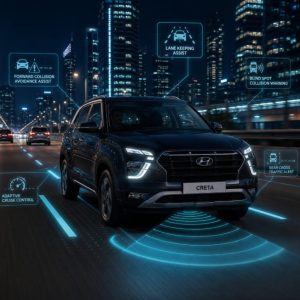
One of the biggest examples of AI integration in the Hyundai Creta is its Level 2 ADAS package. This system combines multiple safety technologies that work together through machine learning and sensor-based decision-making. One of the vehicle’s most important safety technologies is its forward collision avoidance feature. By combining radar sensors with front-facing cameras, the system can detect vehicles, pedestrians, and cyclists in the path ahead. When a potential crash risk is recognized, the driver receives an immediate warning. If the driver does not react in time, the system can automatically activate the brakes to help lessen the severity of the impact or prevent the collision altogether.
Lane Keeping Assist is another intelligent safety feature available in the Hyundai Creta. Using front-mounted cameras, the system continuously tracks lane markings. When the vehicle begins to move out of its lane without a turn signal activated, the technology can provide subtle steering adjustments to guide it back to the center of the lane. These features show how AI is moving beyond simple alerts and becoming an active safety partner during driving.
Smart Cruise Control and Driver Monitoring
The Hyundai Creta also uses artificial intelligence in its adaptive cruise control system. Unlike traditional cruise control, smart cruise control can maintain a safe distance from vehicles ahead. The AI system continuously analyzes traffic flow and automatically adjusts speed. This reduces driver fatigue during highway travel and helps maintain smoother traffic flow.
Driver Attention Warning is another valuable safety technology included in the Hyundai Creta. Since fatigue and distracted driving are common factors in many road accidents, the system monitors steering input, driving habits, and overall vehicle movement for signs of reduced focus. When it detects unusual driving behavior that may indicate tiredness or inattention, it sends a warning to encourage the driver to take a break. This type of predictive monitoring demonstrates how AI can identify risks before they become dangerous situations.
Blind Spot Detection and Rear Safety Features
Changing lanes and reversing are common situations where accidents occur. Hyundai uses AI-powered monitoring systems in the Creta to improve visibility in these areas. Blind Spot Collision Warning uses radar sensors to detect vehicles that may not be visible in the side mirrors. If another vehicle is in the driver’s blind spot, the system warns the driver with visual and audio alerts. In some situations, the car may also assist with braking to prevent side collisions.
Rear Cross Traffic Collision Avoidance is another useful feature. While reversing out of parking spaces, the system scans for approaching vehicles from either side. If it senses a possible collision, the AI system alerts the driver and can apply emergency braking if necessary. These technologies are especially useful in crowded city parking areas where visibility is often limited.
AI and Real-Time Decision Making
One of the greatest advantages of artificial intelligence in vehicle safety is its ability to respond quickly. Human reactions can slow down because of stress, distraction, or fatigue, but AI-driven systems in the Hyundai Creta are designed to analyze situations almost immediately.
The vehicle’s sensors continuously collect information about the surrounding environment, including nearby vehicles, road markings, and potential obstacles. AI-powered software then evaluates this data against pre-programmed safety conditions and driving scenarios. From there, the system can provide alerts, recommend corrective actions, or automatically activate certain safety features within moments. Because of this rapid, real-time processing, the technology helps reduce the risk of accidents that can occur when human responses are delayed.
Improving Passenger Confidence
Safety technology is not only about accident prevention. It also affects driver confidence and passenger comfort. Many drivers feel more secure knowing the vehicle is actively monitoring road conditions and assisting when needed. For new drivers, AI-supported systems can provide additional confidence when handling traffic, highways, or parking. Experienced drivers also benefit from the extra layer of protection during long journeys or difficult weather conditions. Hyundai’s focus on intelligent safety positions the Creta as a practical SUV for families and daily commuters who prioritize safety and convenience.
The Future of AI in Hyundai Vehicles
Artificial intelligence in cars is still developing. Future Hyundai models are expected to include even more advanced capabilities such as improved autonomous driving, predictive maintenance alerts, and smarter traffic communication systems.
As AI technology improves, safety systems will likely become more accurate and personalized. Vehicles may eventually learn driver habits, predict risky situations more effectively, and communicate with surrounding vehicles to prevent accidents before they happen. The Hyundai Creta represents an important step toward that future. By combining AI with modern safety engineering, Hyundai is creating vehicles that do more than transport passengers. They actively help protect lives on the road.
Conclusion
The Hyundai Creta demonstrates how artificial intelligence is reshaping automotive safety. Through features like collision avoidance, lane assistance, adaptive cruise control, and blind spot monitoring, AI plays a direct role in reducing risks and supporting drivers.
These systems are not designed to replace human drivers completely. Instead, they act as intelligent assistants that improve awareness, reaction time, and decision-making during driving. As automotive technology continues to evolve, AI-driven safety systems will become even more important in making roads safer for everyone.