
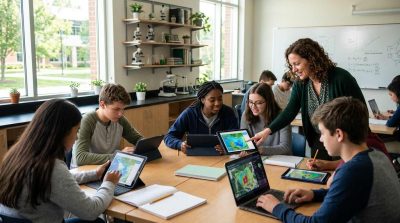
 Advances in technology have affected the way the world is learned, and are now available to the learners. It is through digital means, interactive tools, simulations and online resources. Environmental education can become more interesting and engaging with the use of these technologies, enabling the learner to discover the complex issues in new ways. Technology can be a means to bridge the gap between education and environmental challenges, ranging from monitoring environmental conditions to studying ecosystems virtually.
Certain environmental processes take place over a long duration of time or over a large area.
Technological Assistance for Environmental Research
Check the following:
Identify different types of sensors and the methods for collecting data.
With the use of modern technology, researchers or students can gather environmental information by means of sensors and monitoring devices. This can be as diverse as water conditions, air quality, temperature and other environmental factors.
Real data can be used to improve the learning of how scientific information is obtained and interpreted.
Geographic Tools Give New Eyes to Geography
Use of digital maps and geographic information systems can assist students in the analysis of change on the landscape. Can identify patterns associated with forests, cities, agriculture, waterways etc. Geographical visualisation can help to understand environmental relationships.
Preparing for What is to Come
See below:
1-Creating Digital and Environmental Skills
The need for individuals who are knowledgeable in both concepts and modern technology is becoming more in demand with environmental issues. The merging of these areas in education can contribute to the acquisition of students’ effective analytical and problem solving skills.
2-Encouraging Responsible Innovation
Technology has an environmental impact as well. Responsible use of devices is a key area of environmental education as they need materials, energy and infrastructure. Students are thus able to learn how technology can be used to solve problems but also how it should be used judiciously.
Conclusion
The most powerful resources that technology offers for environmental education are interactive and easy-to-reach information, and real-life data. The use of digital resources, simulations, sensors, and mapping tools can help learners to better understand complex environmental systems and acquire valuable technical skills. As new technologies and education are brought together in a responsible way, it is possible to equip the next generation for responding to environmental issues.